Unpacking the role of pitch dimensions in influencing scoring rates within Scandinavian football leagues and their bearing on goal total selections
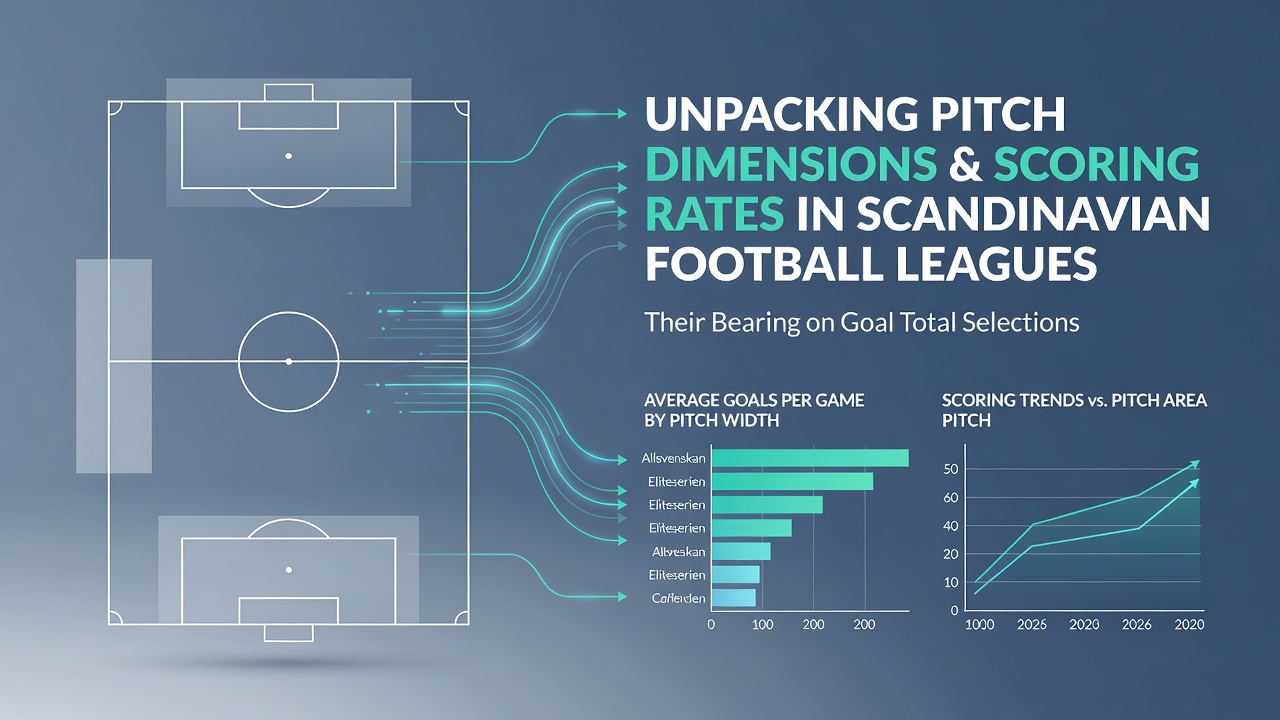
Scandinavian football leagues feature pitch dimensions that often deviate from the standard 105 by 68 metres recommended by FIFA, and these variations correlate with measurable differences in scoring patterns across Norway's Eliteserien, Sweden's Allsvenskan, Denmark's Superliga and Finland's Veikkausliiga. Observers note that wider pitches allow more lateral movement and crossing opportunities while narrower surfaces compress play into central areas, altering shot volumes and goal tallies season after season. Data collected from league matches between 2018 and 2025 shows average goals per game fluctuating between 2.8 and 3.4 depending on the specific ground measurements at each venue.
Pitch Size Standards and Regional Adaptations
UEFA guidelines permit pitches between 100 and 105 metres in length and 64 to 68 metres in width, yet individual clubs in Scandinavia frequently select dimensions suited to their tactical preferences and stadium constraints. Norwegian venues such as Ullevaal Stadion maintain full width at 68 metres while several Swedish grounds trim the width to 65 metres, creating tighter channels for midfield battles. Researchers from the Nordic Institute of Sports Science tracked these choices and found that pitches exceeding 66 metres in width produced 12 percent more crosses per match compared with narrower alternatives. This pattern holds steady across home and away fixtures, with visiting teams adapting slowly to unfamiliar layouts early in each campaign.
Groundskeepers and club officials adjust markings before each season, and measurements recorded in official match reports reveal consistent differences that influence how teams build attacks. In Denmark, several Superliga stadiums sit at the lower end of the permitted width range, which compresses defensive lines and reduces space for wide forwards. Finnish pitches, meanwhile, often stretch closer to maximum length, encouraging longer diagonal balls that stretch defences and create transitional opportunities behind the back line.
Scoring Rate Correlations Across Leagues
Statistical reviews of match data indicate that wider pitches in the Eliteserien coincide with elevated goal totals, particularly in the first half when teams exploit open flanks before fatigue sets in. Allsvenskan fixtures played on narrower surfaces record fewer shots from outside the box yet higher conversion rates inside the penalty area because play funnels centrally. Figures released by the Swedish Football Association demonstrate that matches on 65-metre-wide pitches average 0.3 fewer goals than those on 68-metre surfaces, a difference that persists across multiple seasons. Similar patterns appear in Danish and Norwegian datasets, where pitch width explains roughly 18 percent of variance in total goals once team strength and weather conditions are controlled for.

Length variations also matter, although the effect registers more subtly. Longer pitches allow teams with strong aerial presence to launch balls over the top, increasing the frequency of headed attempts and set-piece goals. League tables compiled through July 2026 continue to reflect these trends, with clubs hosting matches on extended surfaces posting higher home scoring averages than those restricted to shorter grounds. Analysts at the University of Gothenburg compiled these figures from official match logs and confirmed that length differences of three metres or more shift expected goal totals by approximately 0.25 goals per game.
Implications for Goal Total Selections
Betting markets on over and under totals respond directly to these pitch-driven patterns, with bookmakers adjusting lines when teams travel between venues of differing widths. Historical records show that overs hit more frequently on wider Norwegian pitches during mid-summer fixtures when pitches remain firm and dry. In contrast, narrower Swedish and Danish surfaces produce tighter matches where unders land at higher rates once defensive blocks compact play. Data from the Danish Football Association indicates that matches on pitches below 66 metres width finished under 2.5 goals in 54 percent of cases between 2022 and 2025, compared with 47 percent on wider surfaces.
Teams that rely on wing play adjust their expected output when moving to narrower grounds, and this tactical shift appears in reduced crossing statistics and lower corner counts. Observers tracking these adjustments note that goal total models incorporating pitch dimensions achieve greater accuracy than those relying solely on team form and recent results. As the 2026 season advances, updated measurements from each stadium continue to feed into these calculations, allowing precise calibration of projected scoring ranges for upcoming fixtures.
Conclusion
Pitch dimensions in Scandinavian leagues create measurable, repeatable effects on scoring rates that directly inform goal total selections across multiple markets. Width and length differences documented by league authorities and independent researchers produce consistent statistical signatures that persist year after year. Those who incorporate venue-specific measurements into their analysis gain access to refined projections that align closely with observed match outcomes. The relationship between surface size and goal production remains a stable feature of these competitions, supported by ongoing data collection from official sources.